

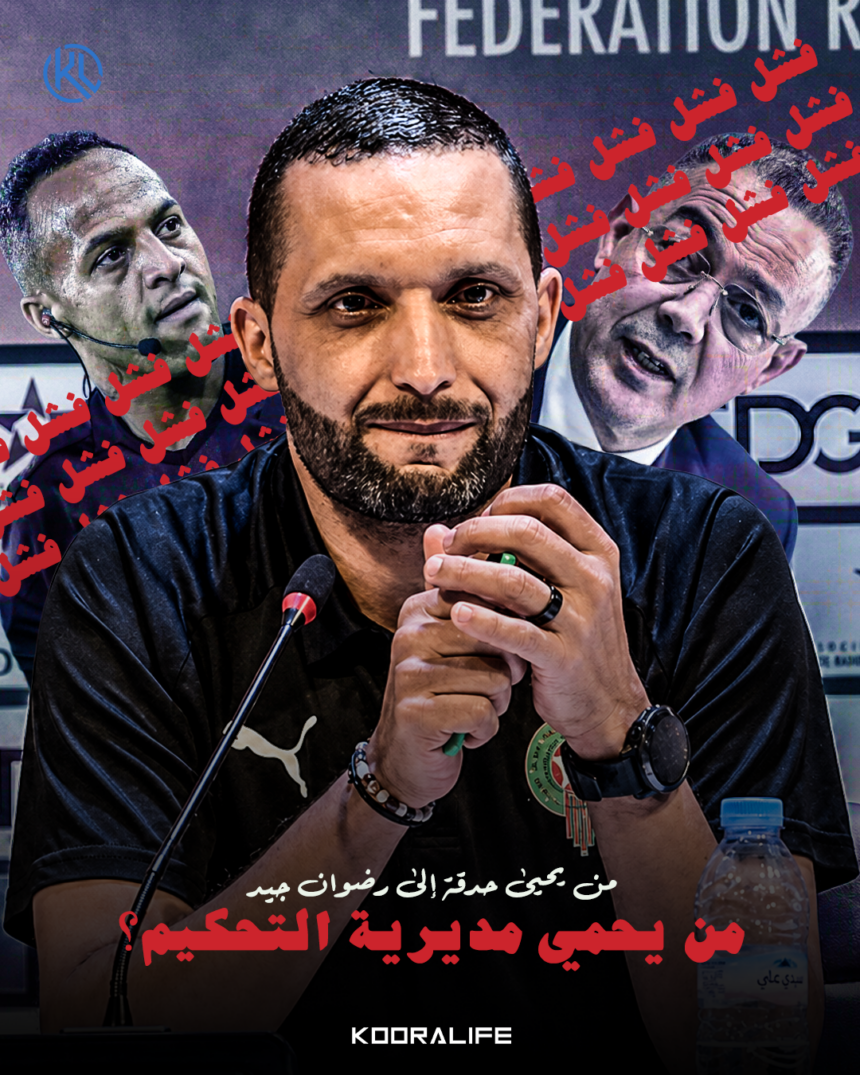
What is happening in the professional championship is no longer just isolated cases but has become a repeated version of the same scene every week: grave refereeing errors, controversial decisions, and a level that is increasingly deteriorating to the point where describing it as a “scandal” has become normal. Since the era of Yahya Hadqa, during which years of failure were ingrained, up to the stage of Ridwan Jid, on whom many pinned hopes for change, nothing has fundamentally changed because changing names without addressing the roots of the system was merely reproducing the same crisis on a deeper level.
Today’s scene reveals an even darker reality: referees lacking physical readiness, suspensions occurring silently without any explanation, retirements due to a sense of injustice, and favoritism lacking the simplest standards of fairness. The arbitration system in Morocco is no longer just suffering but has become immersed in chronic dysfunctions, managed with a mindset that does not keep pace with the game’s development nor respects the aspirations of the stakeholders and fans.
The urgent question is, who protects the Arbitration Department? And who grants this failure the cover to continue? The voice of the fans is no longer ignorable; it has been demanding real reform for years, not limited to changing faces but targeting an entire system in which dysfunction has become the rule, not the exception.
When Ismail Al-Fath was called upon to assess the situation and propose solutions, some thought this was the beginning of a serious corrective path. However, the statements of Bouchouaib Al-Harsh, who confirmed the appointment was made without his knowledge, reflected an implicit rejection of any external intervention. Such a reality can only obstruct any reform attempt, especially for someone accustomed to working in a professional environment like the United States, before confronting chaos so complex that it is difficult even to delve into its details, leading him to withdraw quietly and leave the field to those accustomed to managing failure.
Even more astonishing is the silence of the Royal Moroccan Football Federation and its weak handling of a file that has drained national football for years. While the professional league has limited influence, full responsibility lies with the federation, which seems unprepared to take bold decisions. Some official stances have even complicated the situation further, such as considering the use of foreign referees a “scandal” while the local refereeing is going through one of its worst phases.
The undeniable truth is that reforming arbitration requires courageous decisions, starting with acknowledging the depth of the crisis and not ending with bringing in foreign expertise capable of imposing standards of integrity and discipline. Using foreign referees or arbitration management does not mean excluding local competencies but creating a competitive environment that raises the level and restores the concept of refereeing justice.
Today, postponement is no longer an option. The Royal Moroccan Football Federation is required to fully assume its responsibility, abandon the patchwork approach, and break away from outdated ideas. Continuing the current situation means only one thing: further decline and further loss of trust in a system that is supposed to protect the integrity of the game, not witness its collapse.