


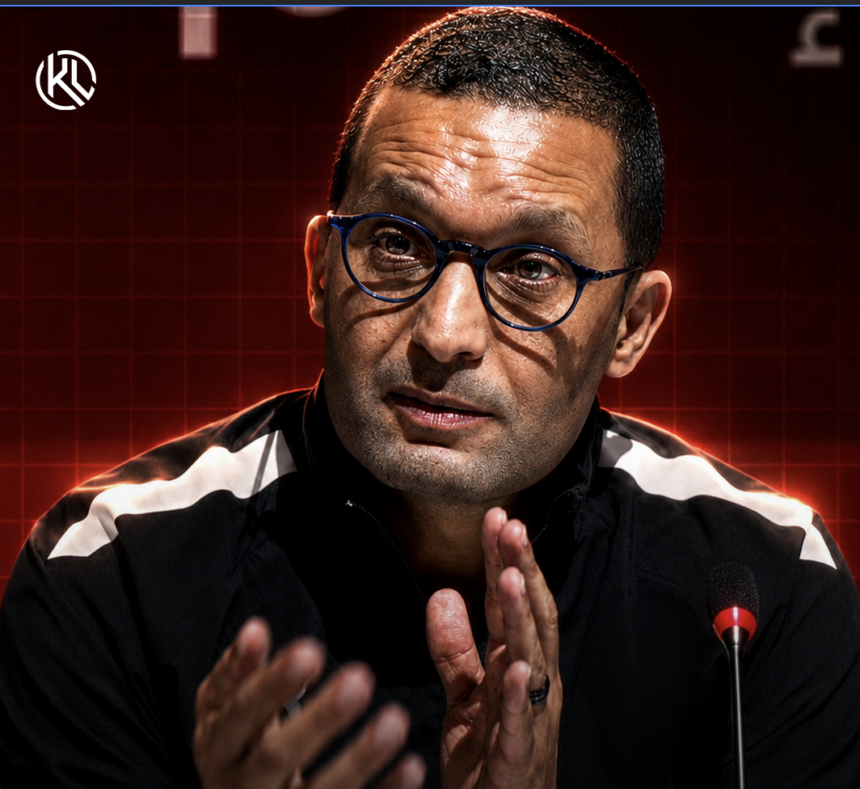
A Miserable Media Outburst by the Refereeing Directorate Titled: “We Are Always Right”
The recent media outburst by the Refereeing Directorate did not meet the expectations of followers, nor did it match the scale of the crisis that national refereeing has been experiencing for years. The directorate came out to say it wants to “spread the culture of refereeing,” but in reality, it presented a cold defensive speech, devoid of acknowledgment, far from self-criticism, and charged with a superior tone implying that the fault lies with the audience, the press, and the clubs, not within the system itself.
Mr. Director Ridwan Jayid began his intervention proudly mentioning the company contracted two years ago to evaluate referees. However, a simple search about this company, which is based in Estonia, reveals that it works with football small countries such as San Marino, Gibraltar, Kuwait, Luxembourg, Latvia, and others. A company of this scale apparently found its niche with the Royal Moroccan Football Federation, making the federation its biggest client, without the directorate providing any clear data on the contract’s value, benefits, or real impact on the level of Moroccan refereeing.
After that, it was the turn of Freddy Votrel, responsible for video technology in Morocco, who tried to justify the failure of the “VAR” experiment with figures showing a reduction in refereeing errors after the adoption of the technology. However, the reality on the fields and the volume of repeated protests from clubs and fans pose a simple question: Where does this improvement appear? And is giving general figures enough to convince an audience that sees controversial decisions every week with their own eyes? Instead of talking about the core of the problem, Votrel chose to focus on the technical side of screens and devices, as if the refereeing crisis in Morocco was only about cables and cameras, and not about decisions, laws, and contradictory implementations.
Among what was also presented was the discussion about contracting a company specialized in semi-automatic offside line detection, under the pretext of developing the process and increasing accuracy. This company will provide more than 14 devices at different angles of the pitch, each equipped with a dual camera capable of showing 100 images per second instead of the current 25 images. On paper, this seems like a technical advancement, but the more important question remains: Is Moroccan refereeing’s problem about the number of images per second, or about those who read these images, interpret the law, and have the courage to unify standards and admit mistakes?
The mention of the derby referee being equipped with a chest camera was one of the strangest moments of this outburst, as if what is truly missing in our refereeing is just an additional camera on the referee’s chest. The public does not demand a new angle image as much as it demands a correct decision, clear communication, respect for their intelligence, and actual accountability for those who err.
Even stranger was the statement that video assistant referees (VAR officials) rely on footage not shown to viewers on television broadcasts when making decisions. This statement opens a huge door for doubt rather than closes it. If there are decisive clips the audience doesn’t see, why not show them? Should the viewer accept a critical decision based on footage they cannot see or verify? It seemed as if these clips were a military secret, forbidden content, or indecent footage.
When a journalist logically asked for a discussion about cases from the national championship instead of citing cases from foreign leagues, the director responded angrily: “We’re not here to discuss refereeing cases, we came to spread the culture of refereeing.” Here the true nature of the speech appeared. The problem is not only in the mistakes, but in the refusal to discuss them. The directorate wants to explain to the public what they should understand but does not want to hear what the public sees every week.
This response is closer to a call to falsehood than to institutional communication. Its direct meaning is that the Refereeing Directorate does not err, and that others just don’t understand. The directorate knows everything, while journalists, fans, and clubs know nothing. It’s as if we do not live in the age of the internet and information flow, as if the average fan does not watch at least four matches a week from the strongest leagues in the world, does not compare cases, and does not accumulate practical understanding of the game laws through viewing and repetition.
Football laws are no longer a secret kept behind closed doors, nor exclusive to those who have undergone training for days or months at an academy. These laws are available to everyone, and refereeing cases are discussed daily in all leagues with images, replays, analysis, and sometimes acknowledgment. Therefore, asking the public to silence in the name of “refereeing culture” is nothing but an attempt to evade the core of the discussion.
The truth is that refereeing, in large part, is neither a mysterious science nor a profession above criticism. For many referees, it is a side job practiced on weekends after official working hours and a means to improve monthly income. Thus, there is no meaning in exaggerating it or presenting it as a law only understandable to those who entered a training center. Yes, refereeing needs training and experience, but it needs before that integrity, courage, clarity of standards, and the ability to admit mistakes.
The Refereeing Directorate spoke about companies, cameras, screens, offside lines, and chest cameras, but it did not provide what the football street was waiting for: clear acknowledgment of mistakes, explanation of nationally controversial cases, clarification of contradictions, and real commitments to accountability.
In the end, the media outburst was nothing but a cold message to the public: We understand, and you do not. We explain, and you learn. We do not err, and you misunderstand.
And this is exactly what makes the refereeing crisis deeper than a mere error in a match. It is a mental crisis, a communication crisis, and a responsibility crisis.