

Since Hicham Ait Mana ascended to the presidency of Wydad Athletic Club, the scene appeared to mark the beginning of a long-awaited “rescue” phase, especially after the departure of Saeed Nasiri, whose name is associated with a golden era not easily surpassed. Wydad fans, naturally hungry for titles, gave the new president unconditional trust, pinning hopes on a swift return to the podium. But what happened on the ground was closer to a free fall than a cohesive sports project.
Wydad, which just a few years ago was the African champion and a regular finalist, quickly transformed into a team that bids farewell to continental competitions at the group stage or fails even to qualify. This transformation was not fate but a direct result of a series of hasty decisions that made the club seem as if it were managed by trial and error rather than by planning.
Ait Mana entered strongly, raised the level of promises, then started executing randomly. Hiring coach Mokouenna was the first test but he failed clearly despite the time given. Bringing Brazilian players without real contribution misled fans into believing titles were just a matter of time. Then came the team’s participation in the Club World Cup, where Wydad appeared pale, and the president chose to compete with an interim coach, resulting in zero points, a scene unworthy of the club’s history, even if the last match was against Al Ain.
Because superficial solutions do not solve a deep crisis, Ait Mana continued the same approach. “Star” signings like Hakim Ziyech, Wissam Ben Yedder, and Nordin Amrabat brought some hope, and the team achieved a winning streak that returned them to the top with games in hand. But the surprise came at an inexplicable time: selling key players such as Lorsch, Aziz Ki, and Zemraoui at the season’s start, as if the team had excess strength, not a need for stability.
Then came the final blow: a harsh elimination against Olympic Safi in a match Wydad was 99 out of 100 likely to win. Instead of calm analysis, the president decided to “restart the game,” dismissing a top coach and bringing Patrice Carteron at an absurd time. The result? A physically and mentally broken team, a coach who earned two points from 15, before he was also dismissed the same way, as if the club lives in a cycle of impromptu decisions.
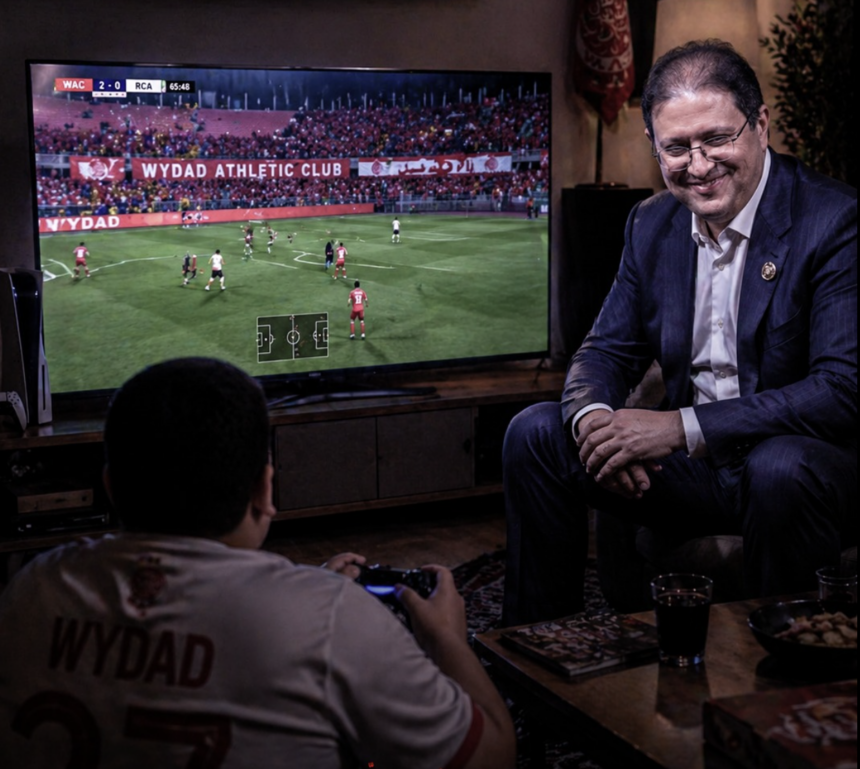
The problem today is no longer in the coach or players but in the management mentality. Ait Mana makes decisions reactively, not with vision. He changes, fires, sells, and signs without showing any thread linking it all to a clear project. Worse, he ignores a simple fact: the problem is not with the “game” but with who holds the controller.
Most surprisingly, the man was present during Saeed Nasiri’s era and closely observed how major teams are managed, but chose a completely different path, a path that proved failure in record time. Instead of self-review, he continues repeating the same mistakes, as if changing coaches has become a substitute for changing thinking.
Behind all this looms another factor that cannot be ignored: election-related pressures. The president, who arrived with a contentious reputation in Mohammedia, tried to reinvent himself in Casablanca through kooralife’s gateway, relying on the club’s overwhelming popularity. But when political calculations mix with sports management, the outcome is often disastrous. Today, after only a few months, Ait Mana faces the prospect of leaving empty-handed: no notable sports success, nor a political gain to build on.
Wydad is bigger than being managed by a “PlayStation” logic, where settings can be reset after every loss. This is a club with history, fans, and continental weight. If this chaos continues, losses will not only be in a season or a title but in the identity of a team once a benchmark of stability and success.