


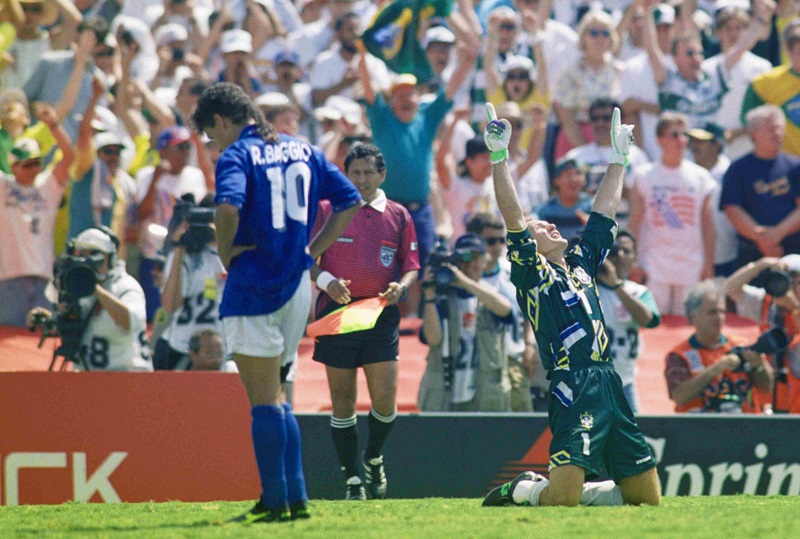
The 1994 World Cup final in the United States marked a turning point in the history of the game, as it was the first time that the final was held and decided by a penalty shootout.
The tournament itself witnessed a huge public turnout, confirming the global expansion of football, even in a country where the sport was not very popular at the time.
On the sporting front, the competition was characterized by balance and strong defense from many teams.
The Brazilian team, led by stars Dunga, Romario, and Bebeto, showed great effectiveness by adopting a realistic style that combined tight defense with offensive efficiency.
Conversely, the Italian team had a remarkable journey led by its star Roberto Baggio, who defied injuries and scored crucial goals in the knockout rounds against Nigeria, Spain, and Bulgaria, leading the “Azzurri” to the final.
The final match, held at the “Rose Bowl” stadium in Pasadena, between Brazil and Italy, was a tactical battle par excellence, with each team closing spaces for their opponent.
Both regular and extra time ended in a goalless draw (0-0), marking the first time in World Cup history that the final ended without goals. With the tension mounting, the two teams resorted to penalty shootouts to decide the title, a historic precedent for this stage of the competition.
Brazil demonstrated greater skill in executing the penalty kicks, while Italy faltered. The most dramatic moment was when Roberto Baggio missed Italy’s final penalty by shooting the ball over the crossbar, crowning Brazil with its fourth title in history with a 3-2 victory on penalties, in a scene engraved in the memories of football fans.
The 1994 World Cup final left a dual legacy; on one hand, Brazil’s title established them as a team known for realism and resilience, and on the other hand, this final entered history with its unique and drama-filled ending.
This tournament also confirmed football’s continuous global development by attracting new fans and strengthening its position as a worldwide sport.