

Since Hicham Ait Mana took the helm as president of Wydad Athletic, the scene seemed like the beginning of a long-awaited “rescue” phase, especially after the departure of Saeed Nasiri, whose name was linked to a golden era that cannot be easily overlooked. Wydad’s fans, naturally hungry for titles, gave the new president unconditional trust and pinned hopes on a quick return to the winner’s podium. But what happened on the ground was closer to free fall than a consistent sports project.
Wydad, which was a few years ago the African champion and a regular guest in the final stages, quickly turned into a team that bid farewell to continental competitions at the group stages or even failed to qualify. This transformation was not destiny but a direct consequence of a series of hasty decisions that made the club appear as if it were being managed with experimental logic rather than strategic planning.
Ait Mana entered strongly, raised the bar of promises, then began execution randomly. Hiring coach Mokwena was the first test, but he clearly failed despite the time given. Bringing Brazilian players without real additions gave fans the illusion that titles were only a matter of time. Then came the team’s participation in the Club World Cup, where Wydad appeared faded, and the president chose to go with an interim coach, resulting in zero points, a scene unworthy of the club’s history even if the last match was against Al Ain.
Because superficial solutions do not fix a deep crisis, Ait Mana continued the same approach. “Star” signings like Hakim Ziyech, Wissam Ben Yedder, and Nordin Amrabat brought some hope and the team achieved a series of wins that restored its lead despite missing matches. But the surprise came at an incomprehensible timing: selling key pillars like Lorsh, Aziz Ki, and El Amrani at the start of the season, as if the team was overflowing with strength rather than needing stability.
Then came the fatal blow: a harsh elimination against Olympic Safi in a match Wydad was 99 out of 100 times closer to winning. Instead of calm analysis, the president decided to “restart the game,” firing a leading coach and bringing in Patrice Carteron at a nonsensical time. The result? A physically and psychologically collapsed team, a coach who earned two points out of 15 before he too was fired the same way, as if the club lived in a loop of hasty decisions.
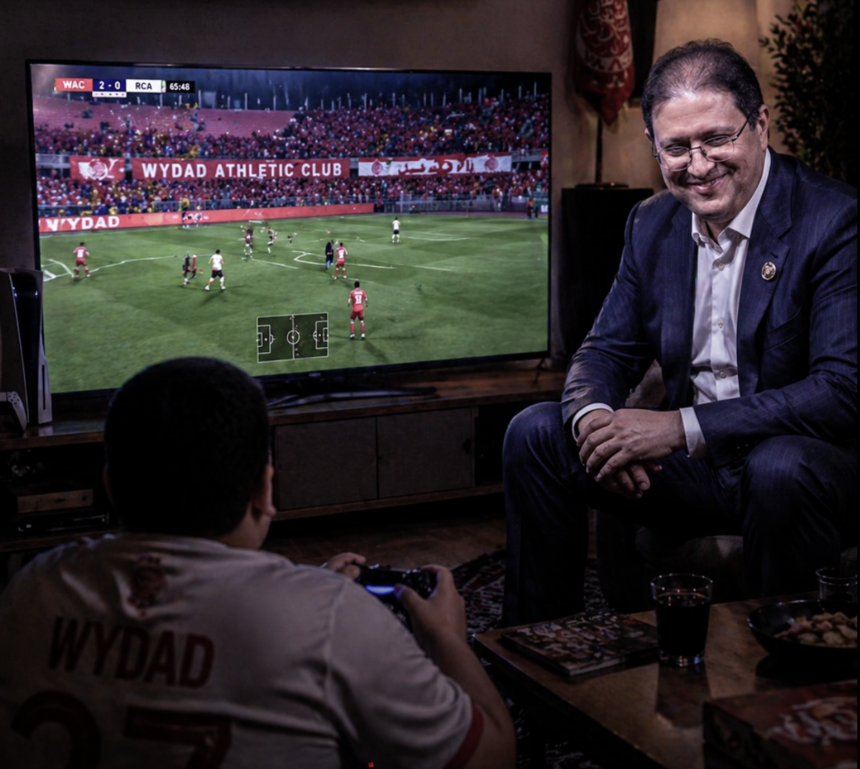
The problem today is no longer with a coach or a player but in the management mindset. Ait Mana makes decisions reactively, not with vision. He changes, fires, sells, and signs without any apparent thread linking all this to a clear project. Worse, he ignores a simple fact: the problem is not the “game,” but who holds the controller.
What is even more astonishing is that the man was present during Saeed Nasiri’s era and witnessed up close how major teams are managed, yet he chose a completely different path, one that proved to fail in record time. Instead of self-review, he continues to repeat the same mistakes, as if changing coaches became an alternative to changing the way of thinking.
Behind all this looms another factor that cannot be ignored: the pressure of electoral stakes. The president, who came with a record full of controversy in Mohammedia, tried to reintroduce himself in Casablanca through Wydad’s gate, relying on the club’s overwhelming popularity. But when political calculations mix with sports management, the result is often catastrophic. Today, after only a few months, Ait Mana finds himself facing the possibility of leaving empty-handed: no notable sports success, no political gain to build on.
Wydad is bigger than being managed with a “PlayStation” logic, where settings can be reset after every loss. This is a club with history, fans, and continental weight. If this chaos continues, the losses will not be just in a season or a title but in the identity of a team that was once a reference for stability and success.